
Case Study: Responsoft 3D Burn Charts
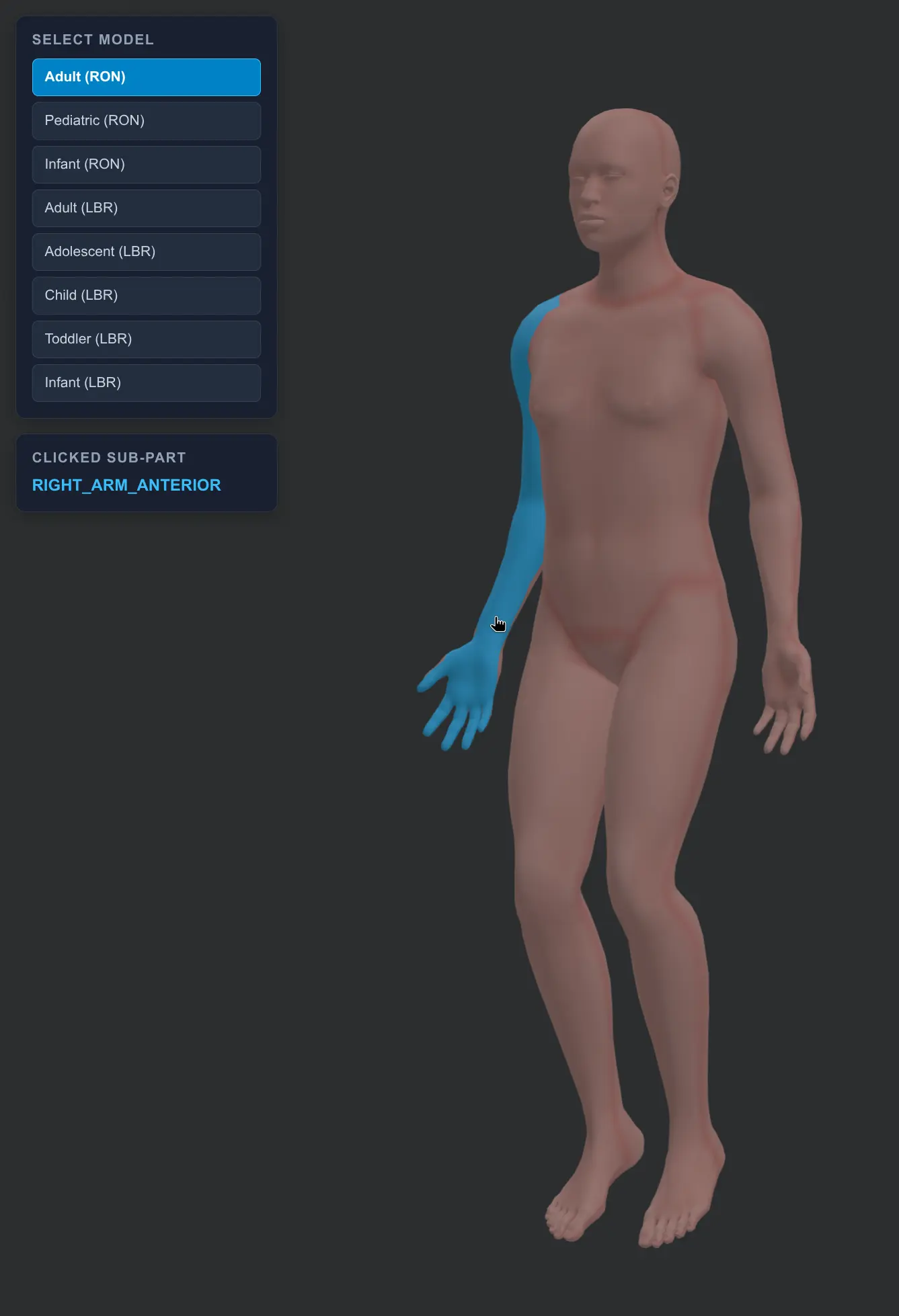
Lyon Ritchie delivered eight web-ready 3D burn chart models for Responsoft LLC to support burn-care training. Responsoft 3D Burn Charts (Burn Charts) translates the familiar 2D Lund-Browder and Rule-of-Nines body diagrams – front and back views with labeled regions and tables of relative percentage of body surface area by age – into selectable 3D anatomy, covering five age groups with Lund-Browder delineation and three with Rule-of-Nines delineation.
The Brief
Estimating body surface area burned is a core clinical skill. Medics record it on 2D Lund-Browder and Rule-of-Nines burn charts: labeled front and back body diagrams paired with tables of relative percentage of body surface area by age, marked as partial or full thickness and totaled as TOTAL BURN.
Responsoft LLC builds interactive EMS protocols – including a Lund Browder body surface burn calculator – and needed those flat diagrams as anatomically proportioned 3D models for five age groups (adult, adolescent, child, toddler, infant). Every chart region needed a clear visual boundary, including a hidden coronal division separating anterior and posterior segments.
The models had to be lightweight enough for web delivery as glTF/GLB, with either 2048px texture maps or vertex coloring, and posed in standard anatomical position – except the infant models, which required a custom "hands near head" pose.
Our Approach
We built the age phenotypes from a MakeHuman base mesh (MPFB2 add-on in Blender), so all five age groups share identical topology and vertex ordering. This let us develop one set of region definitions and carry it across every age group rather than redrawing boundaries five times.
For the region splits we used a Geometry Nodes strategy: Blender objects hold the region data, and switching between Lund-Browder and Rule-of-Nines display is a modifier-level change. Custom scripts automated the repetitive work – creating objects from region string lists and filling Geometry Nodes sockets from object names.
An interactive web-based model viewer (A-Frame + glTF) served as our internal QA tool throughout production. It deep-links to a specific model, reports the name of any clicked region, and highlights the selection – so chart regions and poses could be confirmed and compared in seconds without importing the model into a DCC application.
The Result
The Lund-Browder set ships five files – adult, adolescent, child, toddler, infant – each with 33 distinct anatomical chart regions isolated as separate, uniquely named objects. The Rule-of-Nines set ships three files – adult, pediatric, infant – each with 15 distinct regions. The pediatric phenotype shares the child base mesh, since the Rule-of-Nines groupings do not require a separate body shape.
Materials were optimized for real-time use: baked curvature and 2048px color maps where texture detail mattered, vertex coloring where it kept files light. A custom blend shader in the viewer renders regions from a grayscale mask image, keeping the exported models simple and the runtime flexible.
Client review prompted two refinements that shipped in the final delivery: a relaxed standard-armature pose with helpers for all but the infant models (plus a beefier forearm and wrist shaped to match the reference overlay via shapekey), and an enlarged anterior neck region for the Lund-Browder infant. Late in the project we added a hitbox option to make small regions easier to select in the viewer.
In less than four weeks Lyon Ritchie delivered eight finished models – 210 individually selectable chart regions across the full set – exported as glTF/GLB with textures, plus the web-based viewer with click-to-identify, highlight, and per-model deep links.